You pile up associations the way you pile up bricks. Memory is itself a form of architecture.
— Louise Bourgeois
DIMIN is pleased to present fragile architect(ure), curated by Francesca Pessarelli. Featuring works by Ben Blaustein, Russell Maltz, Alex Stern, and Emerald Rose Whipple, the exhibition examines memory as a constructed, spatial phenomenon—one that resists linear narration and instead operates through accumulation, fragmentation, and reconfiguration.
Memory is often imagined as a linear timeline, moving from childhood to the present like a single, continuous film. In reality, its structure is far more complex and non-linear, composed of flashes of images, sounds, smells, and sensations that assemble, fall apart, and reform in shifting configurations. Visual memory functions as an anchoring framework onto which the rest clings. With each permutation, details shift: some surface while others disappear, new connections emerge, and dormant moments are reactivated. The mind becomes a sort of modular house—one we move through, dismantle, and rebuild. As details are decontextualized from the larger narrative of a moment, they form loose piles of bricks that may one day be picked up and reassembled. I remember meeting this person, but from where? What does this scent remind me of? Who does this laugh belong to? These fragments may click back into place with the proper trigger—a mutual friend, a childhood perfume, a family video—or remain as tantalizing clues to a room whose key has been lost.
The artists in the show approach structure, image, and time in distinct ways, yet together they construct this fragile architecture. Russell Maltz’s reductive installations employ found materials from construction and architectural sites to create compositions that feel both physically and temporally suspended. In his Needles, thin strips of glass, metal, and plywood are layered and hung from a simple nail that pierces each element at its balance point. In Maltz’s Stacks, painted glass and plywood lean against one another, either directly on the floor or atop an aluminum shelf. The materials are familiar yet enigmatic. By recomposing objects with prior lives, Maltz erases their original contexts, collapsing the separation between object and space. Painted shapes appear to float within the layers, disrupting distinctions between object and form and causing the compositions to subtly shape-shift. While the works themselves are not modular, the viewer’s experience is: as one moves around them, new structures are revealed while others recede.
Alex Stern’s paintings are composed of sensitively rendered hand-painted lines interwoven with partially or fully obscured images, text, symbols, and collage. These elements—carriers of concrete information—are absorbed into the larger structure of the painting, rendering them abstract. Carefully layered lines of varying opacities build up the surface like a tapestry, resulting in a composition that feels like something between a scaffold and a forest. In contrast to their structural rigor, the paintings reject temporal linearity, often incorporating recognizable references to popular culture within a vocabulary rooted in abstract expressionism. Images hover within this matrix, as if they could emerge from or dissolve back into the depth of the painting at any moment. The impulse to extract meaning gives way to an invitation to simply feel. In the Metal Bars works, Stern foregrounds the architecture of painting itself by extending stretcher bars beyond the canvas and crossing them at each corner. By making the support visible and echoing it in the line work, Stern renders the relationship between image and structure modular, allowing surface and support to fold into one another and continuously recombine.
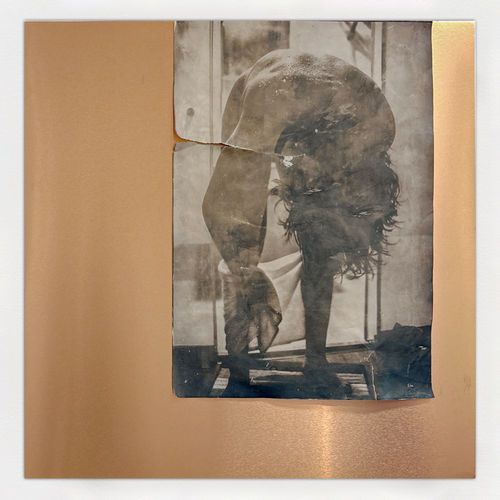
Ben Blaustein’s works similarly employs the instability of images as carriers of narrative. Beginning with photographs—often intimate scenes of family and close friends—Blaustein splices, layers, scans, prints, and washes cyanotypes with botanicals. He then tears, crumples, and reconfigures the prints into dynamic, often sculptural installations. The structures that hold these images together are frequently found architectural elements—wooden banisters, marble slabs, cabinet parts—that once belonged to domestic spaces. These supports pin the images in place as they distort and collapse into one another. An arched back, a reflected face, a mass of tousled hair becomes formal, informing the overall composition. The identities of the subjects blur and dissolve, like a soft faded photograph or a memory with blurred edges. What remains most tangible are gesture and materiality: works that feel precariously assembled, held together by an invisible force. Blaustein’s installations read as collections of moments, scenes, and objects that seem ready to be rearranged should a missing piece re-surface.
Emerald Rose Whipple’s enigmatic paintings draw from a deep personal archive of nights out and gatherings with friends. A single body of work often collapses multiple time periods into one, forging connections through color, energy, and sentiment rather than linear chronology. The images are softly blurred, recalling the low resolution of a phone photograph taken in dim light. The works on view depict friends gathered around a table in the green glow of Mansions in Ridgewood. Candlelight and cigarettes cast distorted shadows reminiscent of Toulouse-Lautrec, while the warmth and intimacy of shared evenings permeate the scene. This hazy rendering mirrors the texture of memory itself: we hear the clamor of voices and laughter but forget the words; we feel the pulse of music but can’t recall the song. Unlike cinema, which relies on dialogue and narrative clarity, memory—and Whipple’s paintings by extension—dispenses with exposition and moves directly to the emotional core: fondness, closeness, exchange. The image becomes the substrate onto which memory attaches, rather than the memory itself.
From the moment we first begin to remember, our minds act as architects—piling bricks, securing what matters, concealing what hurts, discarding what decays. Through cycles of building, dismantling, and rebuilding, an ever-shifting fragile architecture forms around us: the fragile architect.
Fragile architect(ure) takes place in DIMIN's Living Room concurrently to Justine Hill: Everywhen in the main gallery.